Facing a maths wall?
It's easy to end up copying answers, half-learning a method, or carrying a hidden misconception straight into the next lesson.
Math Mitra is a friendly set of teaching agents built on real classroom methods — worked examples, deliberate practice, and checking you actually understand. Pick one, open a chat, and work through it together.
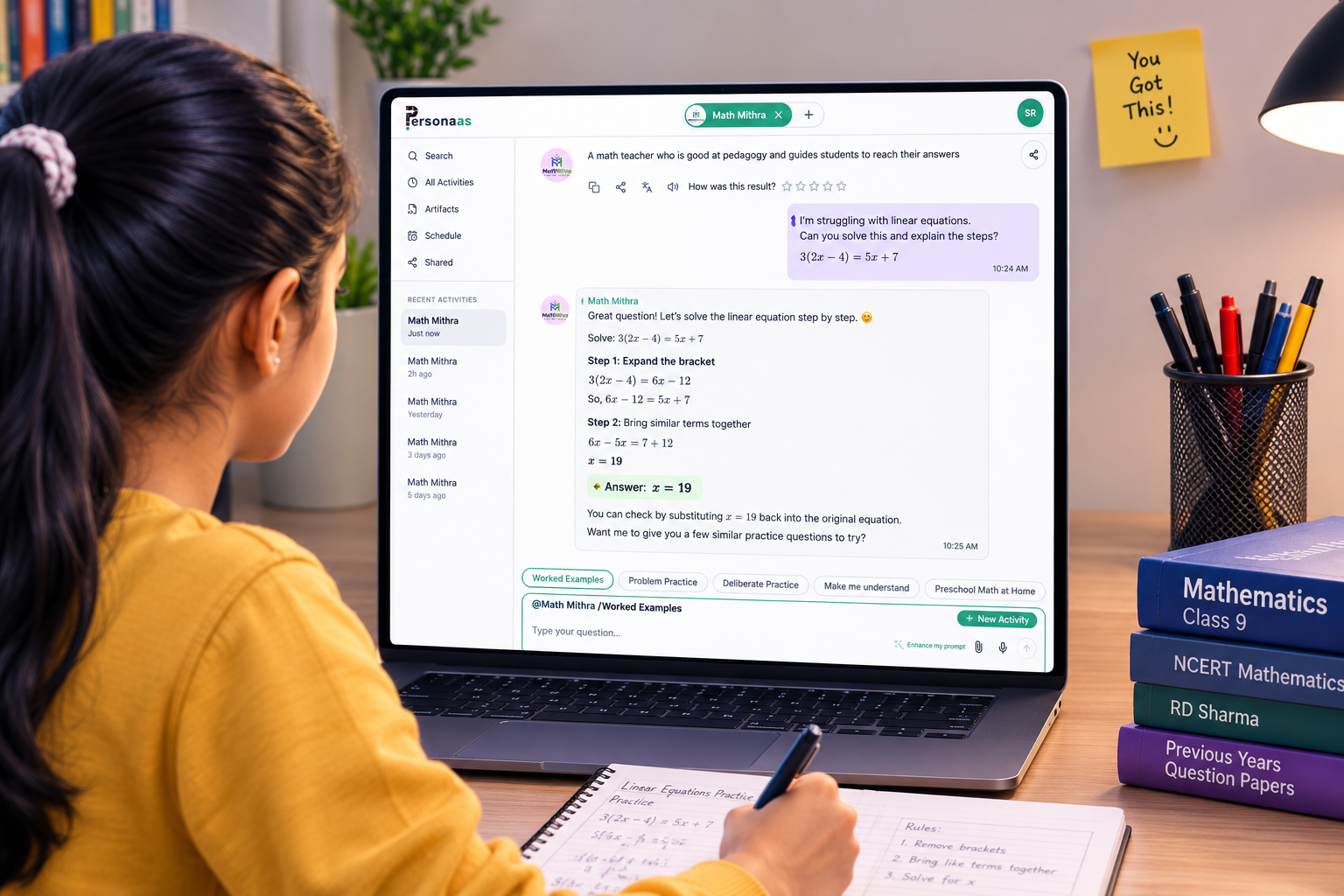
Psst — these aren't answer machines. Each Mitra is built, tested, and constantly updated by real teachers, and coaches you one step at a time so the thinking stays yours.
Every Mitra is built to do two things — help you genuinely understand a concept, then give you the deliberate practice to own it.
It's easy to end up copying answers, half-learning a method, or carrying a hidden misconception straight into the next lesson.
Each Mitra coaches you through understanding, deliberate practice, and honest checks — one step at a time, so it actually sticks.
Each Mitra coaches you one step at a time so the thinking always stays yours. The best classrooms have always done it this way — we've built it into a friendly chat.
Meet a new concept the way the best classrooms teach it — a clear worked example first, not a cold struggle.
One calibrated problem at a time, with prompts and feedback that make you do the thinking instead of handing over the answer.
Diagnostic checks catch misconceptions before they harden, so every session builds on solid understanding.
Five ready now, with more being added all the time. Every one is free to talk to.
Teaches a topic the way the best classrooms do — silent worked examples, “My Turn / Your Turn” pairs, examples and non-examples, then faded steps that hand control back to you. Built on Craig Barton's worked-example method.
Gives you one problem at a time, calibrated to the exact sub-skill you need, and coaches you through it instead of handing over the answer. Uses ready-made five-stage practice plans for common concepts.
A teacher that actually checks whether you've got it — with diagnostic questions and responsive follow-ups — instead of lecturing and asking “does that make sense?” Built on Barton's “Tips for Teachers” principles.
Short, joyful math games using only household items — no worksheets. Ask for a single game, or a full-year schedule and kindergarten lesson plan when you want structure. Builds counting and number sense through play.
Breaks a complex maths problem into the individual sub-skills (“atoms”) a student must hold before they can solve it, then tutors through each one at a time. Based on Craig Barton's atomisation idea from How I Wish I'd Taught Maths — assess each prerequisite, then assemble the full solution.
Real teachers are busy building and tuning new skills — more concepts, levels, and styles. They'll pop up here the moment they're ready.
Learn a method? Practise till it sticks? Check what you know? Each card is built for one of those.
Click through and you're talking right away. Name a concept like “fractions” and go.
One problem at a time, real feedback, and prompts that make you do the thinking.
These are four teaching modes, and each is best at a different stage of learning. Spend a whole week on one concept — and each 15-minute session switches mode to do the job it's best at: introduce it, check it landed, build fluency, then space it out.
Novices learn more from studying a clear example than struggling cold. Best for meeting something new.
Diagnostic questions that verify it landed and catch misconceptions before they harden.
One calibrated problem at a time, coached — for accuracy and speed once the method is understood.
A track of its own for ages 3–6. If your student is that young, use this alone — skip the schedule.
Silent Teacher + a My Turn / Your Turn pair, then one faded example.
Diagnostic questions on Monday's concept. If a misconception shows, re-teach it on the spot with a quick worked example.
One problem at a time on the same concept, coached, building accuracy.
Intelligent variation and slightly harder problems, fading support so they do more alone.
Quiz across this week's concept and older ones — the spaced-retrieval day that keeps earlier material alive.
Off — or one fun “challenge” problem if they're keen.
Worked Examples and Make Me Understand overlap a lot — both are Craig Barton's. You don't need both every week. Make Me Understand mainly adds the diagnostic check, which is why it sits in the Tuesday/Friday “did it actually land?” role rather than as a second teaching day.
Skip the schedule above entirely. The Preschool Math Mitra is its own track — short, joyful games with household items, a game a day, or a full-year plan when you want structure.
None of these run on autopilot. Teachers write the plans, choose the examples, test them with learners, and keep updating them — so the way each Mitra teaches actually gets better over time.
Pick a teacher, name the concept, start working. Free, and waiting.
Choose a teacher →